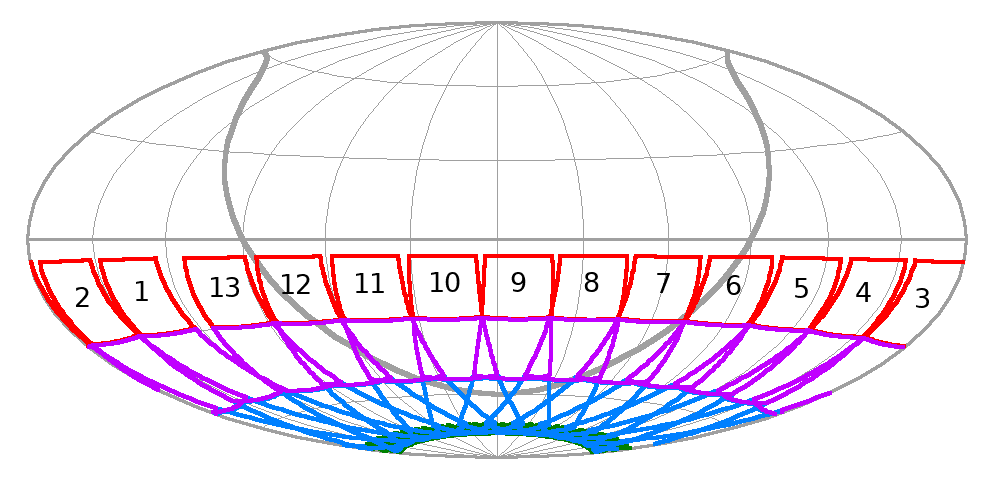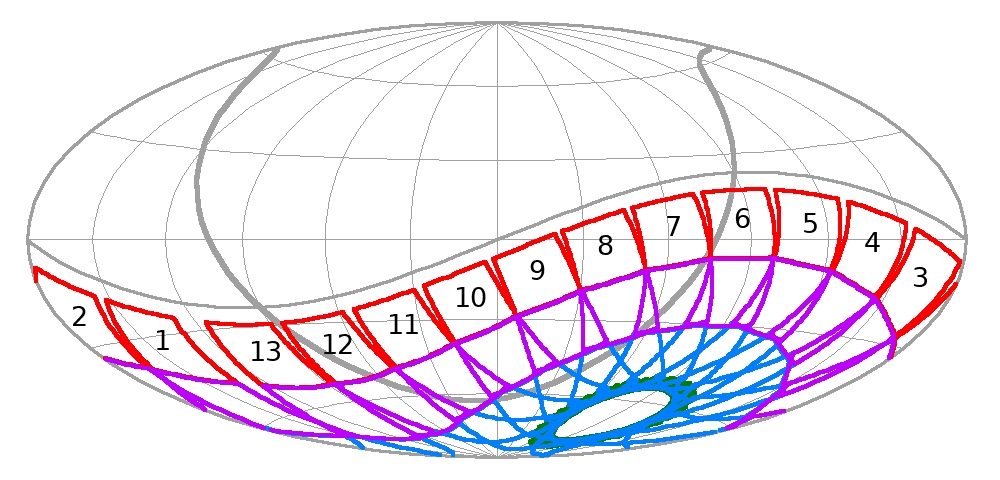
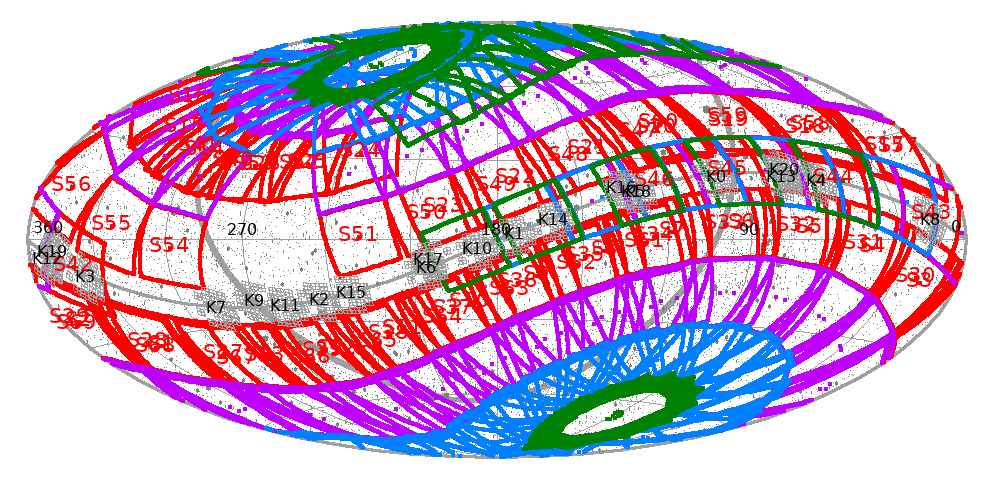
Overlay of Year 1-7 pointings in ecliptic coordinates (upper image) and celestial coordinates (lower image). Maps for individual years and individual ecliptic sectors are shown below.
Current Status
TESS is in Orbit 229, Sector 109. Sector 110 begins on October 31, 2026.
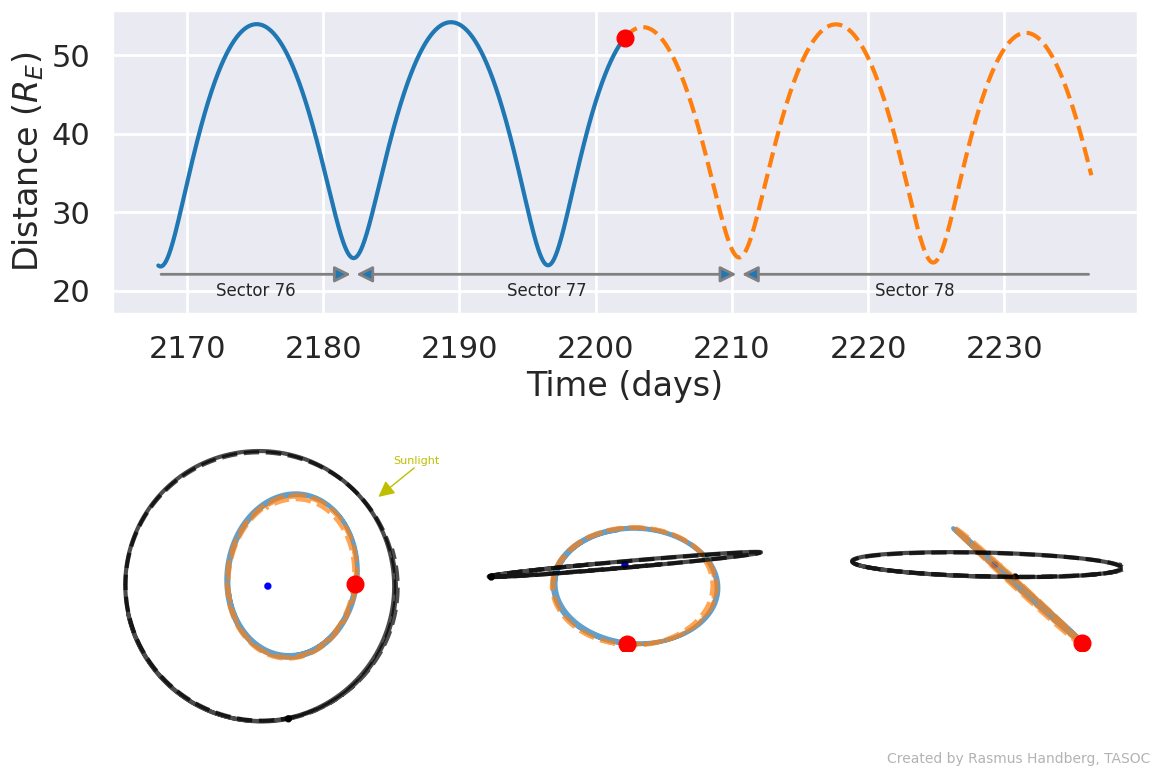
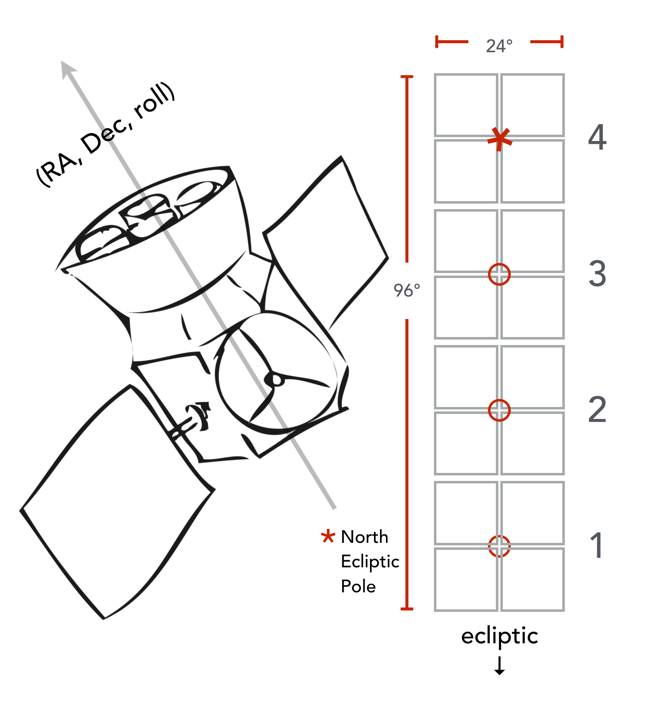
(image shamelessly borrowed from tasoc.dk, which appears to be out of order at the moment)
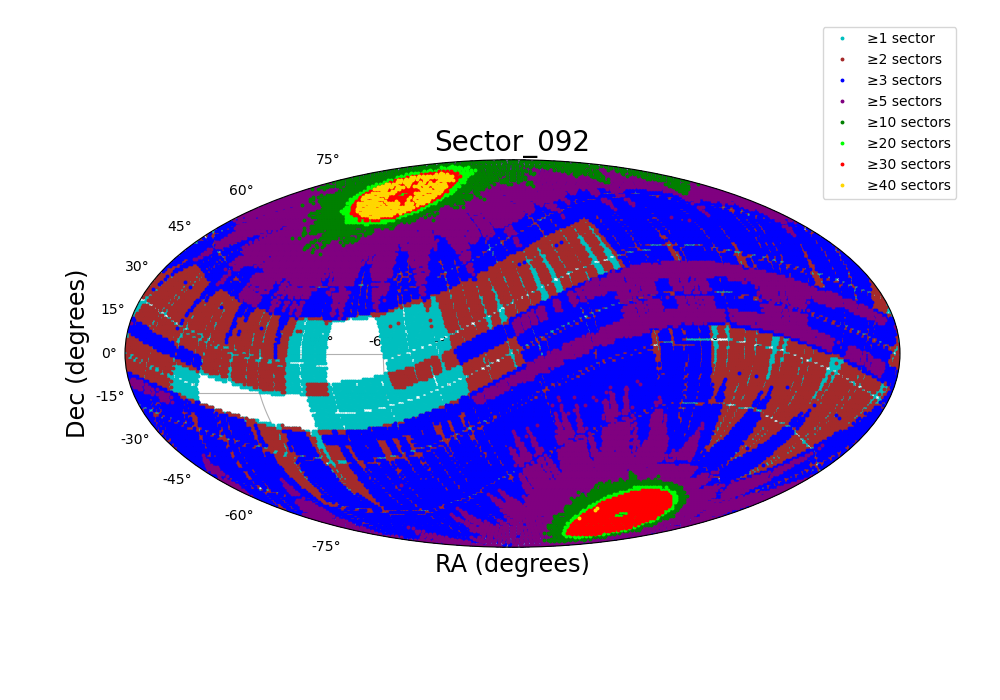
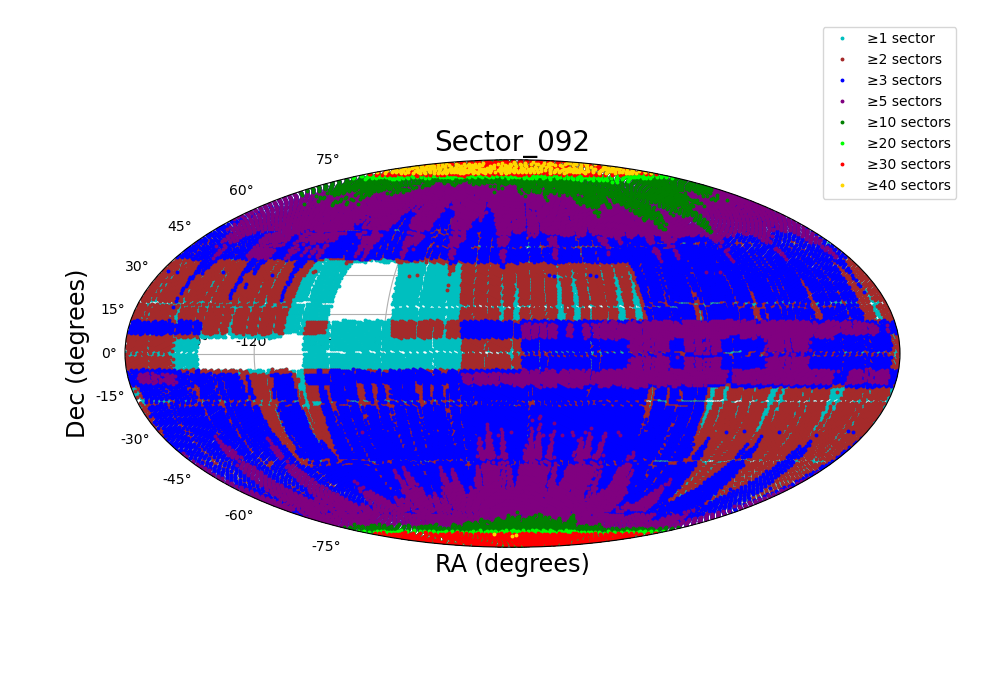
Sky Coverage Map through Sector 92
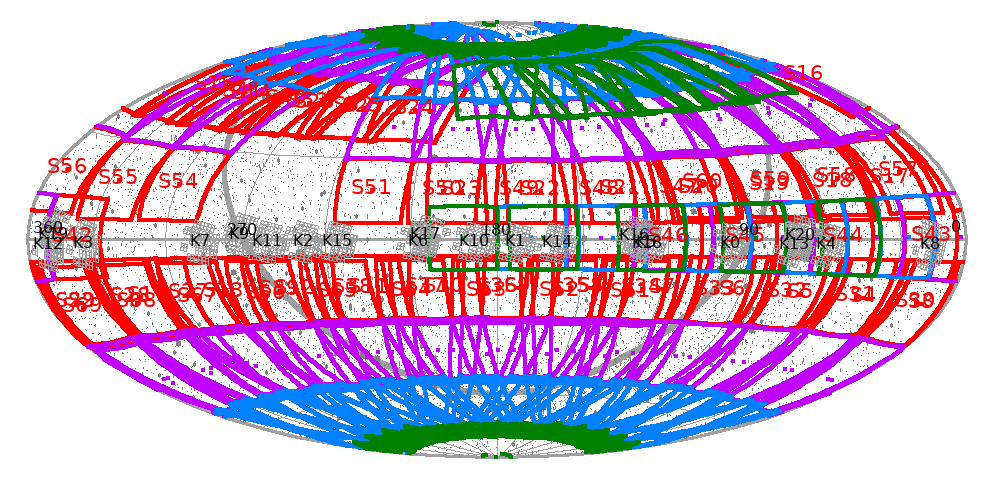
The images below indicate the number of sectors each part of the celestial sphere was observed through Sector 92: at left, in celestial coordinates, and at right, in ecliptic coordinates. The map is color-coded based on the minimum number of sectors observed.
Sector Pointings for Years 1-9
The details of TESS spacecraft orientation for Years 1-8 are given on the pages for each of the years: Year 1, Year 2, Year 3, Year 4, Year 5, Year 6, Year 7, Year 8, and Year 9.
Each page contains a table of pointing for each sector: the columns are Sector number, Start and End dates of Sector, then (RA, dec, roll) in degrees (J2000) of the spacecraft and four camera boresights. Note: All future values are provisional and may be changed, although there are currently no plans to do so.
The full table of Year 1-9 pointings, at higher precision than what is shown below, can be downloaded here.
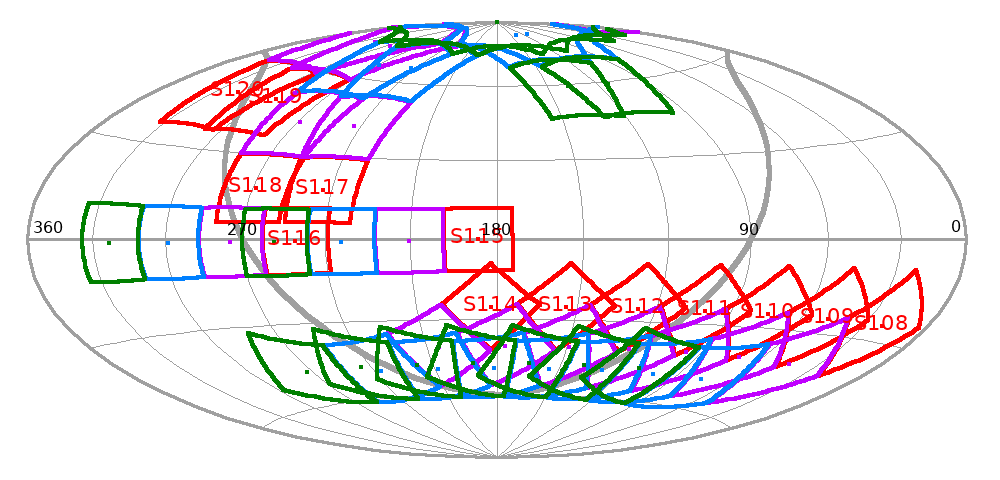
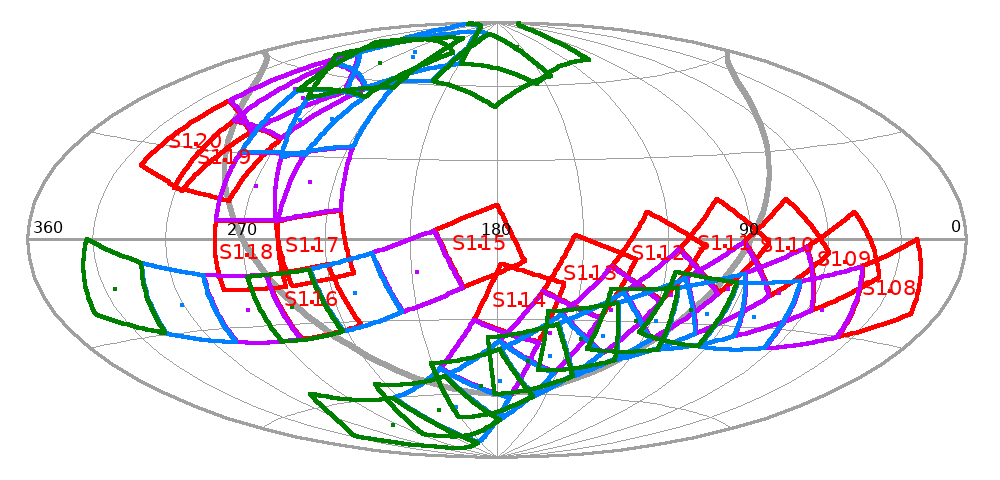
Year 9
Observations during Year 9 comprise Sectors 108-120. Year 9 will begin with the last seven sectors of “rolled” observations in the Southern ecliptic hemisphere, where the instrument FOV will be rotated about its axis by 40° and shifted to provide overlapping observations of the middle latitudes. Following these sectors, there will be two sectors observing the ecliptic, parts of which have not been observed before, and then the first four sectors of an extended campaign in the northern hemisphere. The northern observations will be centered closer to the ecliptic pole to extend the period of observations in contiguous sectors.
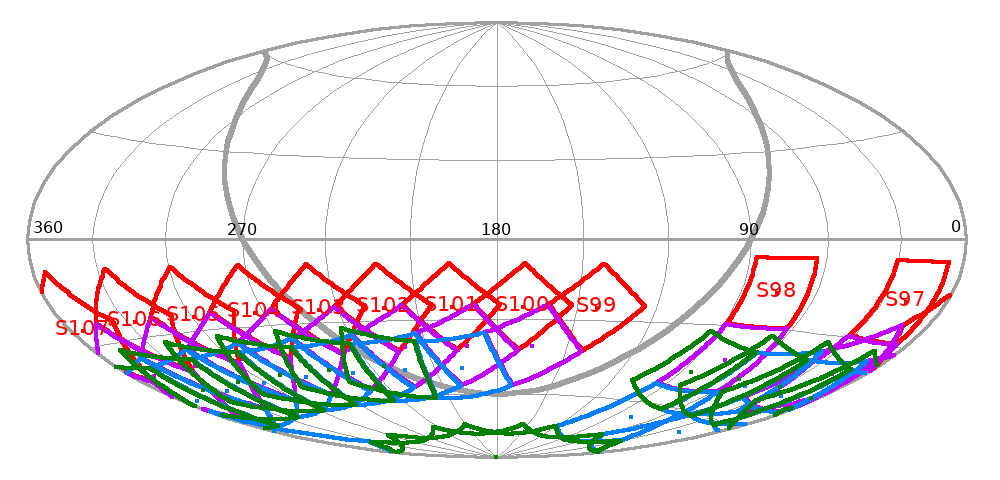
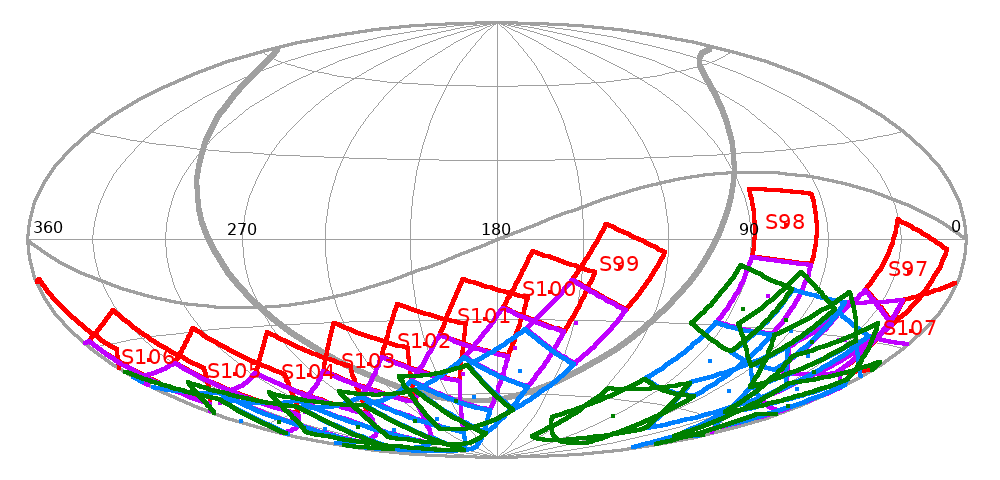
Year 8
Observations during Year 8 comprise Sectors 97-107. Year 8 will begin with two sectors in the Southern ecliptic hemisphere (Sectors 97 and 98), each of which will be comprised of four consecutive orbits (instead of the standard two orbits per sector used in Sectors 1-96). Following these sectors, there will be nine sectors of Southern ecliptic hemisphere observations where the instrument FOV will be rotated about its axis by 40° and shifted to provide overlapping observations of the middle latitudes.
Year 7
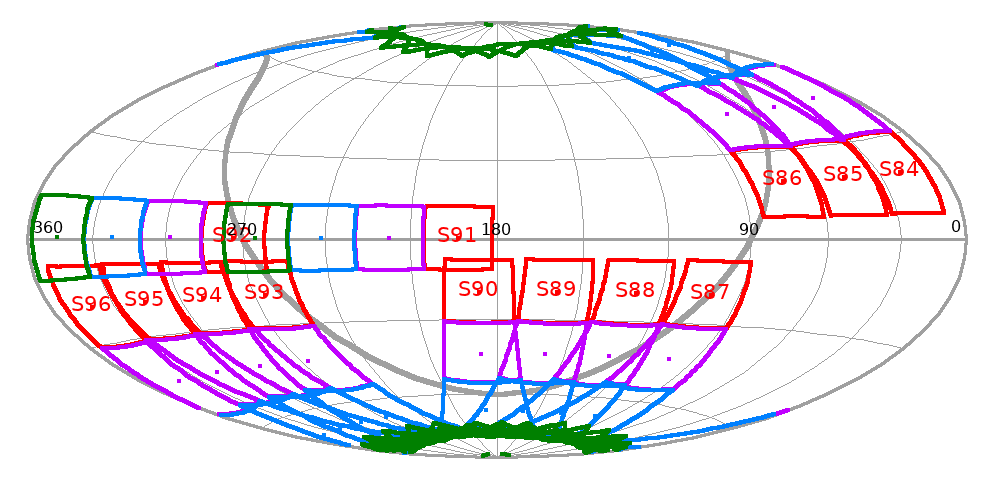
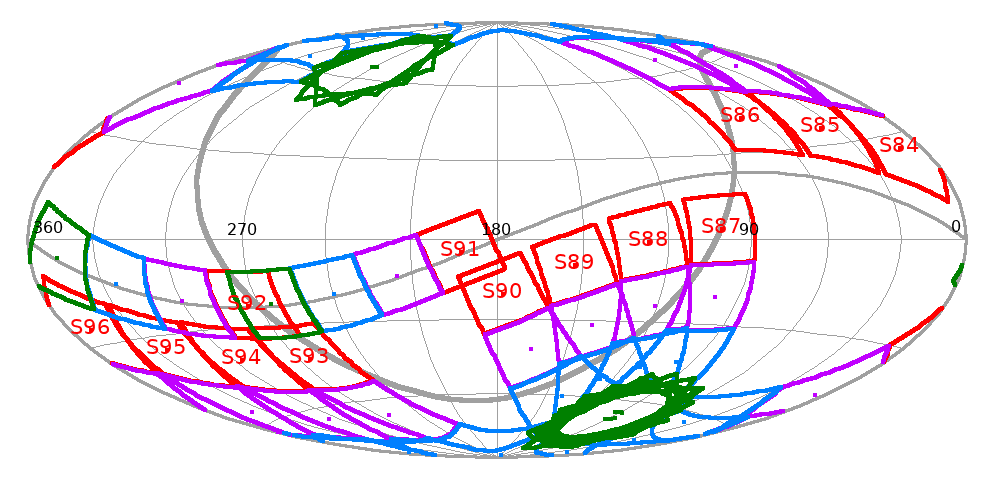
Observations during Year 7 comprises Sectors 84-96. Year 7 will begin with four sectors on the Northern ecliptic hemisphere (Sectors 83-86), followed by a four sectors in the Southern ecliptic hemisphere. Sectors 91 and 92 will be used to take first observations of the 120° section of the ecliptic that has not been observed to date. Year 7 observations will finish with four Southern pointings.
As in Year 6, the ecliptic latitude at which the spacecraft boresight is pointed will be shifted by 1.5° and the instrument field-of-view will be rotated by 1.5° in order that regions of the sky not covered in the first four years of the mission can be observed (these regions are caused by the gaps between CCDs in each camera, and they are most prominently seen at 18° and 54° latitude and at the ecliptic poles).
Year 6
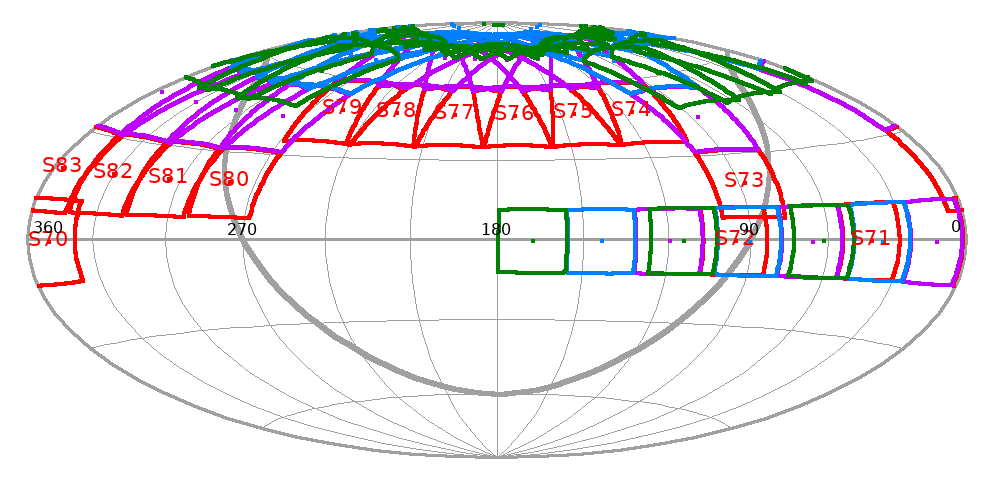
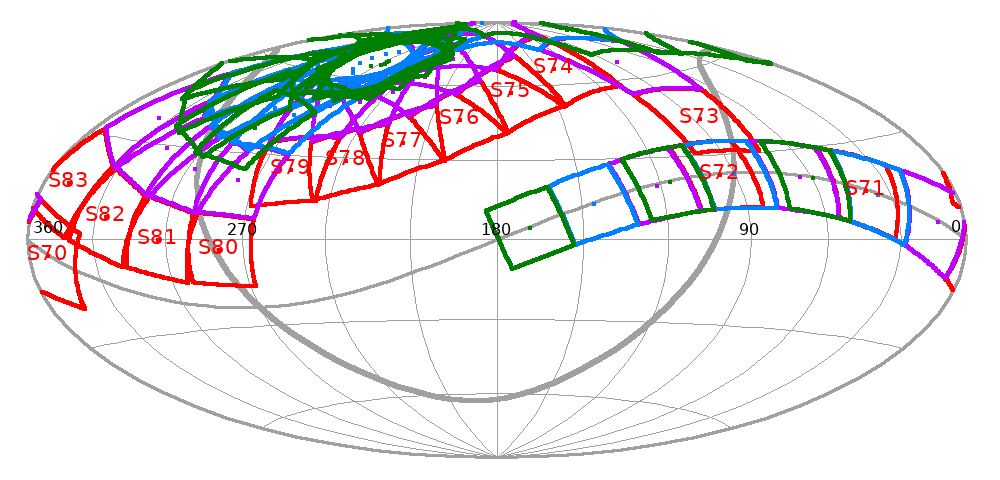
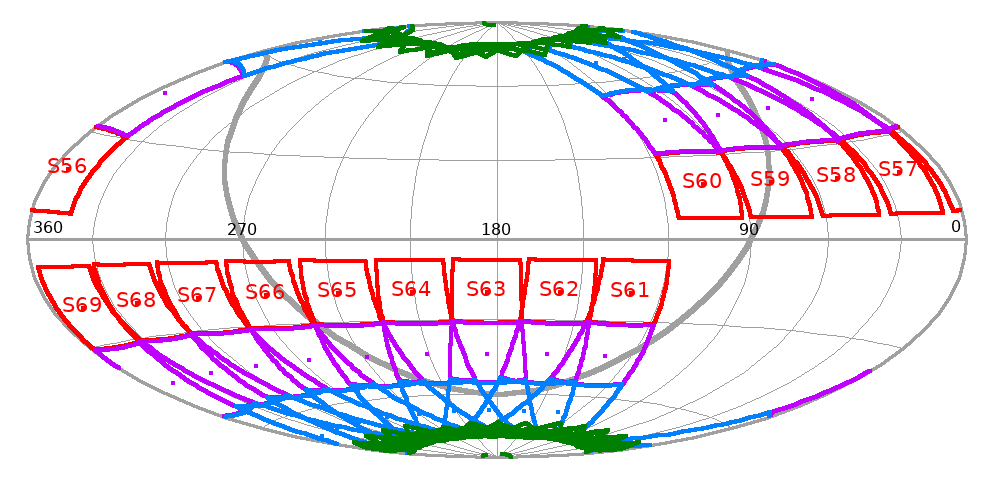
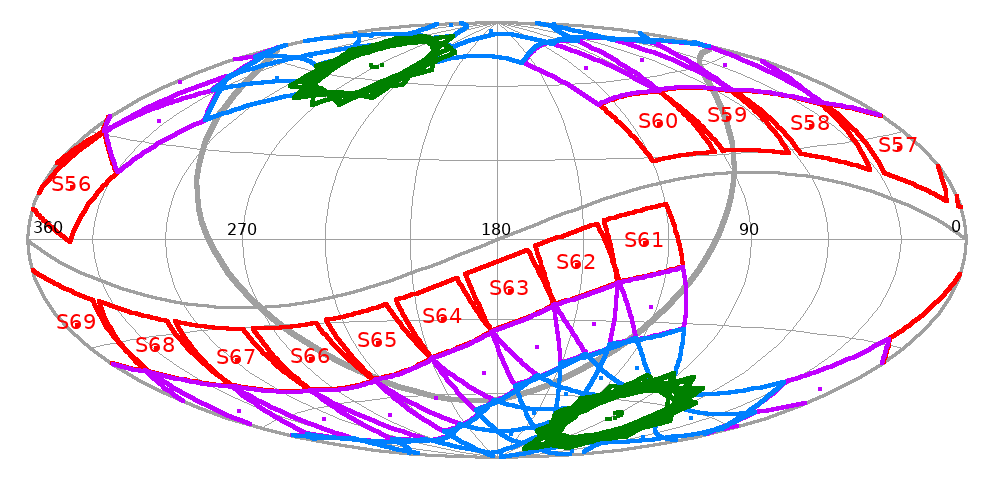
Observations during Year 6 comprises Sectors 70-83. Year 6 will begin with three sectors on the ecliptic (Sectors 70-72), followed by a new scan of the Northern hemisphere will begin (Sectors 73-83). The ecliptic latitude at which the spacecraft boresight is pointed will be shifted by 1.5° and the instrument field-of-view will be rotated by 1.5° in order that regions of the sky not covered in the first four years of the mission can be observed (these regions are caused by the gaps between CCDs in each camera, and they are most prominently seen at 18° and 54° latitude and at the ecliptic poles).
Year 5
Observations during Year 5 comprises Sectors 56-69. During Year 5, the second scan of the Northern ecliptic hemisphere will be completed (Sectors 56-60), and a new scan of the Southern hemisphere will begin (Sectors 61-69). The ecliptic latitude at which the spacecraft boresight is pointed will be shifted by 1.5° and the instrument field-of-view will be rotated by 1.5° in order that regions of the sky not covered in the first four years of the mission can be observed (these regions are caused by the gaps between CCDs in each camera, and they are most prominently seen at 18° and 54° latitude and at the ecliptic poles).
Year 4
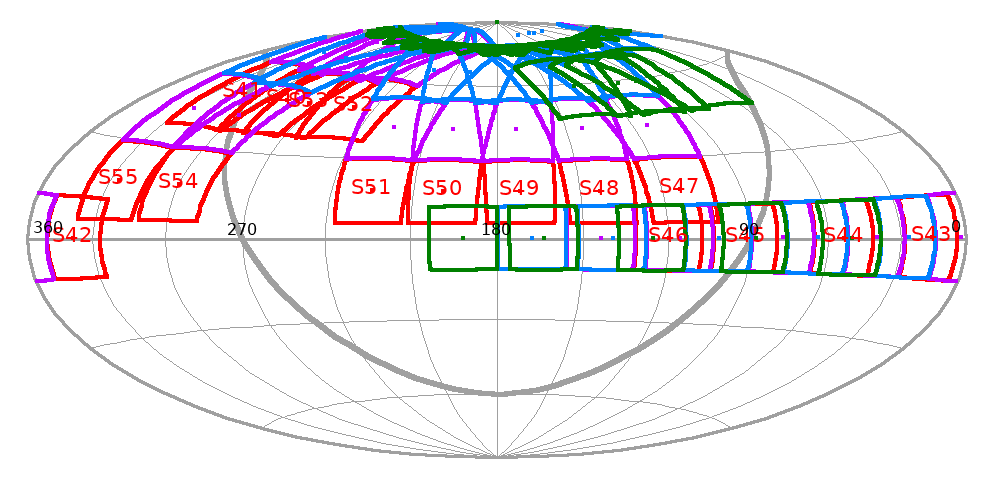
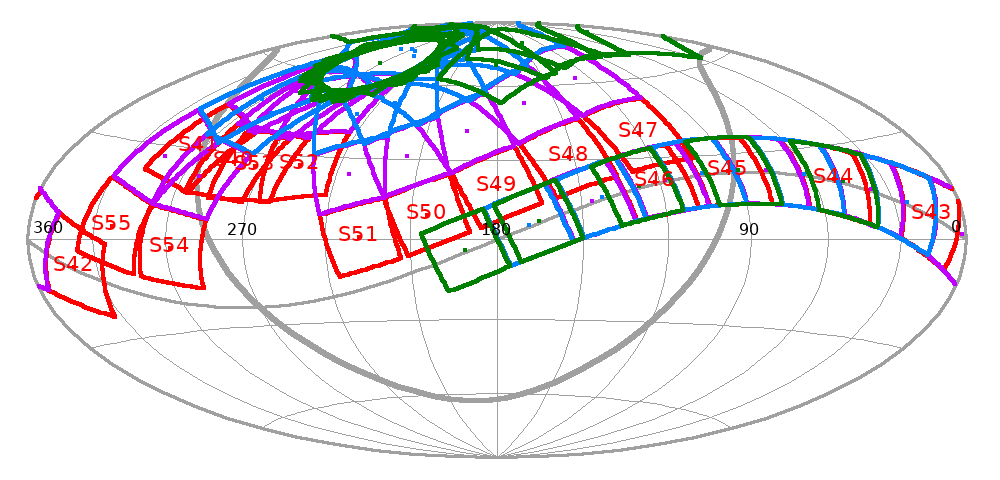
Observations during Year 4 comprises Sectors 40-55. In contrast to Years 1-3, Year 4 comprises 16 observing sectors. Year 4 began with Sectors 40-41 in the Northern hemisphere, pointings roughly equivalent to those of Sectors 14 and 15, at an ecliptic latitude of +85°. In Sectors 42-46, the spacecraft was rotated by 90° in order to observe the ecliptic. Sectors 47-55 are Northern hemisphere pointings at ecliptic latitude of +54°, with Sectors 52 and 53 shifted north to +85° to avoid scattered light in cameras 1 and 2.
Year 3
Observations during Year 3 comprised Sectors 27-39. During Year 3, the southern ecliptic hemisphere was re-observed. For each of these sectors, the instrument boresight was pointed at an ecliptic declination of -54°.
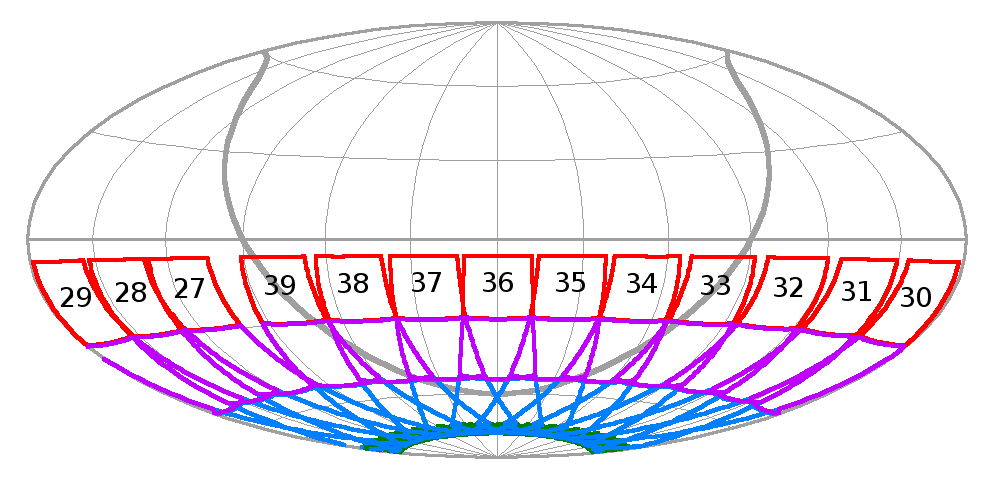
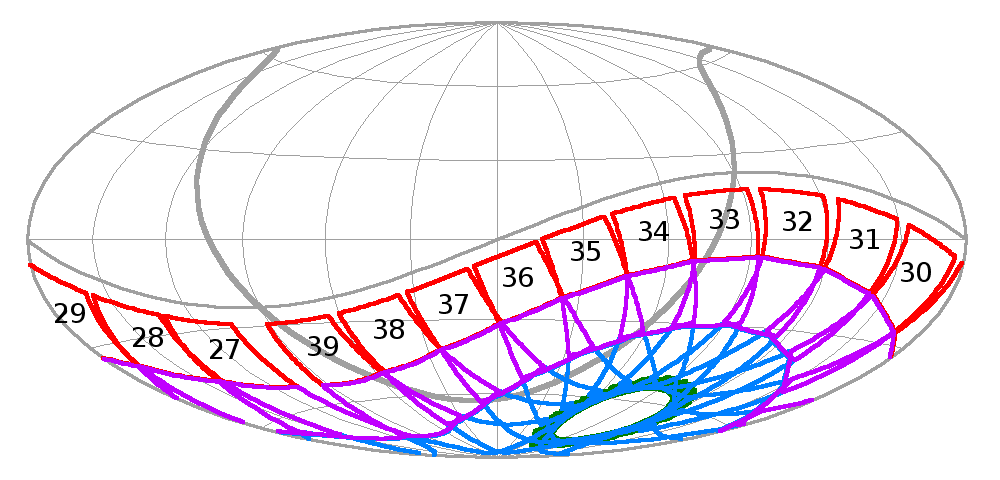
Year 2
Observations during Year 2 comprised Sectors 14-26. During Year 2, the northern ecliptic hemisphere was observed. During sectors 17-23, the instrument boresight was pointed at +54° ecliptic latitude. During Sectors 14-16 and 24-26, the boresight was pointed at +85° ecliptic latitude, to avoid excessive contamination by stray Earth- and moonlight in cameras 1 and 2 in the nominal +54° orientation.
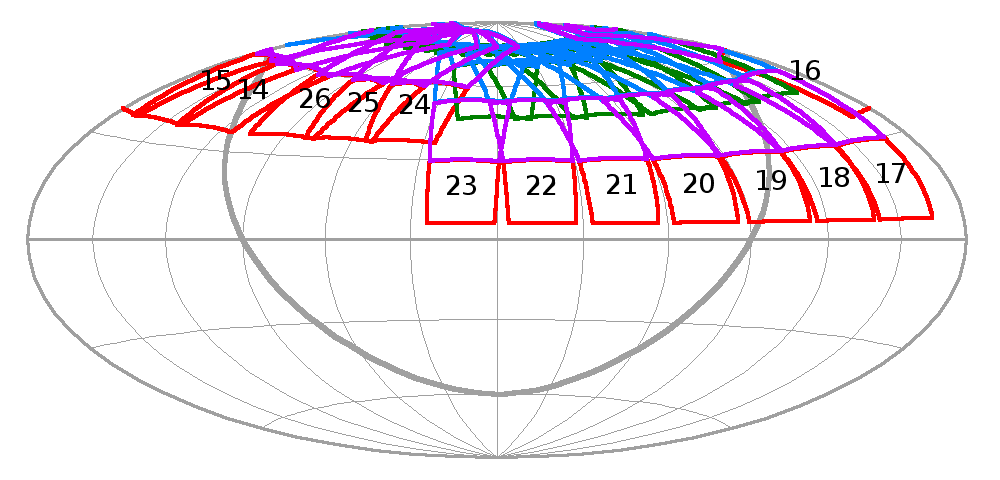
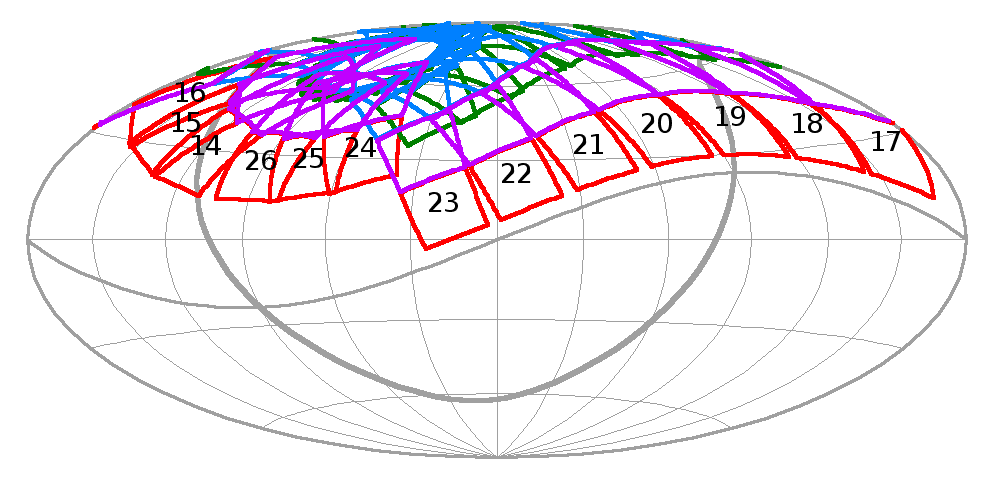
Year 1
Observations during Year 1 comprised Sectors 1-13. For each of these sectors, the instrument boresight was pointed at an ecliptic declination of -54°.