
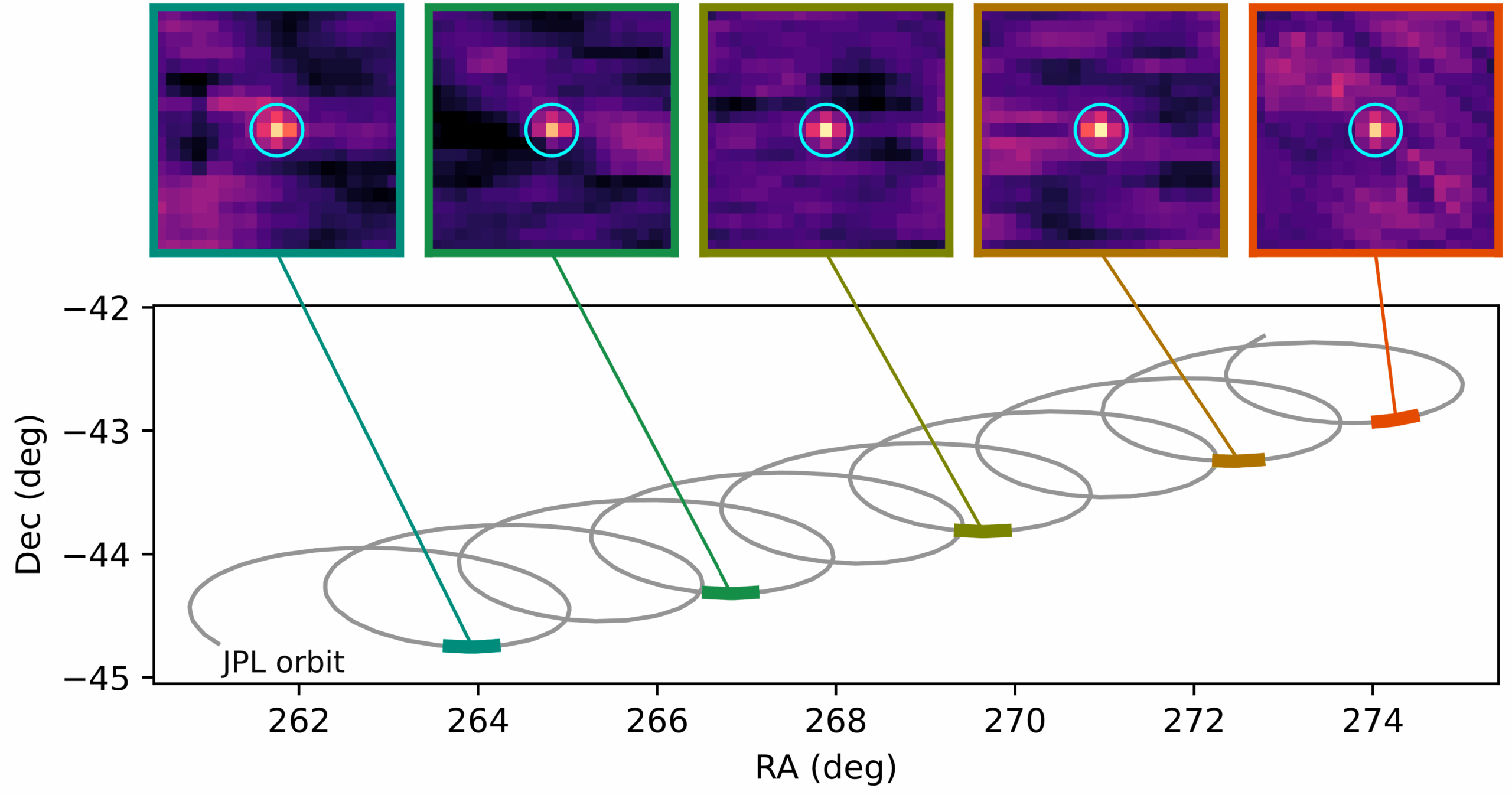
Before anyone knew it was there, NASA’s Transiting Exoplanet Survey Satellite (TESS) had already been watching the solar system dwarf planet candidate 2026 ED138. Searching seven years of TESS images, a team led by MIT researchers found the object in five separate observing periods between 2019 and 2026, four of them before its discovery by the Vera C. Rubin Observatory.
The trans-Neptunian object 2026 ED138 was announced in 2026 October as the first dwarf-planet candidate in our solar system discovered by the Vera C. Rubin Observatory. The Transiting Exoplanet Survey Satellite (TESS) observed it in five month-long sectors between 2019 and 2026, four of them before its discovery.
The object is far too faint to see in any single TESS image, especially against the crowded star fields of the Milky Way. So the team removed the known stars from each image and then added thousands of images together, shifting each one to follow the object’s predicted path. The result is a clear detection. The positions confirm the object’s orbit and TESS’s measurements support its expected brightness and color.
ED138 TESS Precovery paper: https://arxiv.org/abs/2610.40106
ED138 LSST Discovery paper: https://arxiv.org/abs/2610.38693
Media Contacts: Jeroen Audenaert (jeroena@mit.edu) & Te Han (tehan@mit.edu)